
BOP Releases Serving Shelby Cases
No Federal Bureau of Prisons institution was identified inside Shelby County in the official facility sweep. BOP is still relevant when a person is sentenced in federal court. A federal defendant can be held locally for a short time, moved under U.S. Marshals authority, and later committed to a BOP institution elsewhere. A Shelby roster disappearance during that sequence can reflect transfer, not release to the community.
The custody stage determines the right source. SCSO can document a release or transfer from county custody. U.S. Marshals and the federal docket are more useful for a pretrial federal detainee. BOP's locator applies to federal prisoners in its record system, especially sentenced prisoners. PACER provides the signed judgment, sentence change, release order, and later supervised-release proceedings.
| Stage | Correct channel | Key caution |
|---|---|---|
| Local temporary hold | SCSO transaction | Departure may be a federal transfer |
| Federal pretrial custody | PACER and responsible U.S. Marshals district | Person may not yet appear as a sentenced BOP prisoner |
| BOP sentence | BOP inmate locator | Match the federal register number when possible |
| Post-prison supervision | Federal docket and probation record | BOP release does not end all federal obligations |
Search a BOP Release Record
The BOP inmate locator supports two search routes. Search by BOP register, DCDC, FBI, or INS number when one is known. Otherwise use the person's name and narrow results with race, sex, and age. A number search is usually the strongest identity match. Compare all returned identifiers before attributing a federal release result to a Shelby County person.
Use this short process:
- Select the identifier search when a reliable federal number is available.
- Otherwise enter the full name and use only supported filters needed to separate matches.
- Read the name, register number, age, race, sex, release date, and location together.
- Note whether the location says a facility, “RELEASED,” or “IN TRANSIT.”
- Open PACER to verify the judgment, sentence changes, release order, and supervision events.
- Contact the responsible agency when the locator language does not fit the known case stage.
Read BOP Release Results
A past release date with no facility, or a location shown as “RELEASED,” means BOP reports that the person is no longer in BOP custody as of that date. It does not mean the person has no supervised release, parole, pending case, or custody in another correctional system. Use exact language. “Released from BOP custody” is narrower and more accurate than saying the person is entirely free.
“IN TRANSIT” is not a release. It can reflect movement within the federal system or movement involving U.S. Marshals. A result that does not place someone at a BOP institution may require the federal docket or responsible agency to explain the current arrangement. The BOP locator records explanation states that the locator reliably covers federal prisoners released after 1982 and is updated daily. Older cases may require the National Archives.
- Released
- BOP reports the person outside BOP custody as of the stated date.
- In transit
- The person is being moved; it is not a community-release status.
- Supervised release
- A court-imposed period following prison, monitored in the federal system.
- Register number
- The federal identifier used to distinguish people and records.
BOP Locator Source View
The official federal locator search was the successful manifest image specifically assigned to this facility-system page.
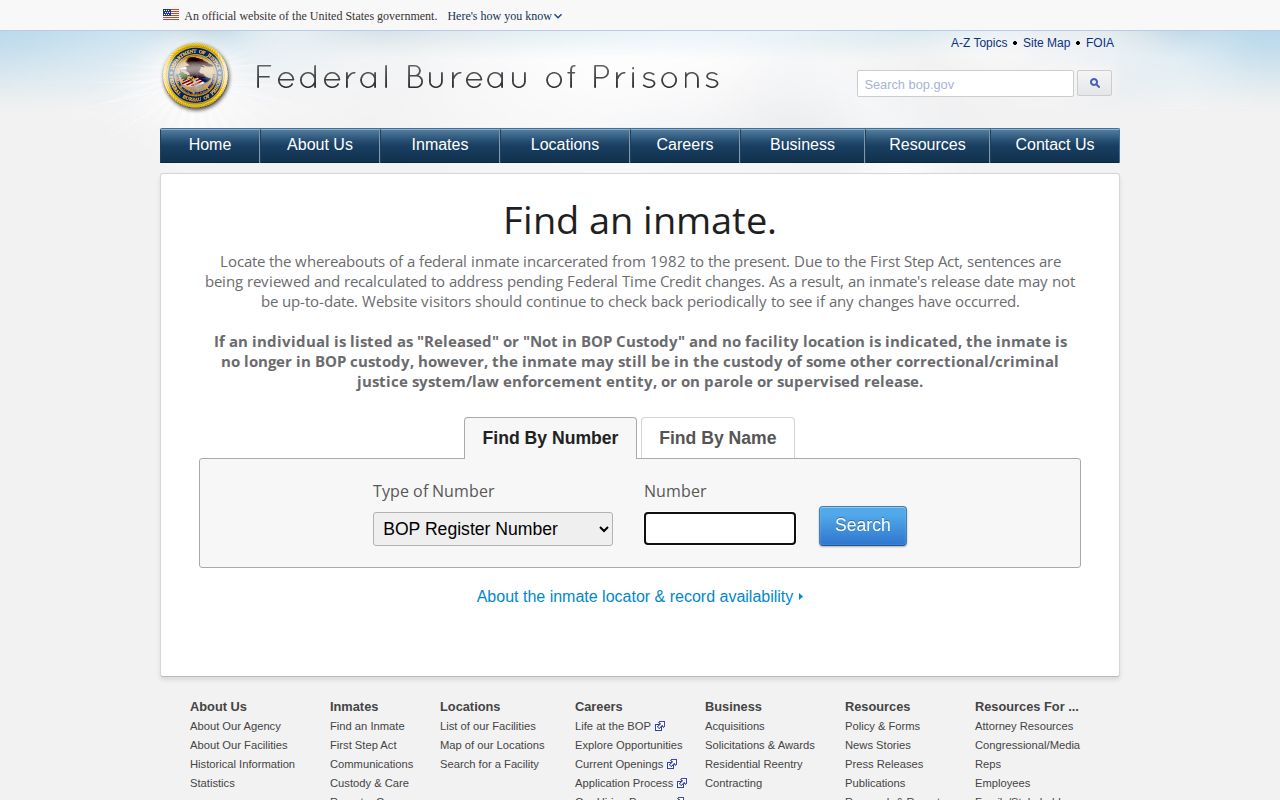
The search form is a starting point. The result must still be matched carefully and read with the federal docket when the legal basis or supervision status matters.
BOP results contain limited public fields. They are not a copy of the full judgment or a full release packet. A docket can show sentence reductions, amended judgments, release orders, and supervised-release proceedings that give context to the locator date. Record both sources and avoid turning an absence or status shorthand into a broader conclusion.
PACER Federal Release Proof
PACER is the federal court-record source for judgments and later docket events. Search the correct federal case and match the defendant with the register number, dates, and other official identifiers. The signed judgment states the prison term and supervised-release terms. Later orders may reduce or modify the sentence, authorize release, or address violations after prison.
The docket is also the better source during the interval before a person becomes a sentenced BOP prisoner. U.S. Marshals can manage federal pretrial and district-court detainees without a public historical locator like BOP's. No BOP result during that interval does not prove release. Ask the responsible U.S. Marshals district or rely on a signed federal court order.
The BOP date and docket play different roles. The locator indicates what BOP reports about custody and departure. The court file supplies legal authority and supervision terms. Together they are stronger than either alone.
Shelby-to-Federal Transfer Record
When a person first appeared at Shelby County Jail, request the SCSO release or transfer transaction. It may name the federal receiving agency, date and time, and authority. The county record proves the local handoff. It does not prove a later BOP release. Follow the chain into the federal source that matches the next stage.
A focused SCSO request identifies the person, approximate booking range, and booking number if known. Ask for the booking-out form, release or transfer transaction, receiving agency, and court or writ authority. Under the Texas Public Information Act, protected fields may be withheld, and the office need not create a new report. Call 936-598-5600 to confirm the preferred request route.
The broader Shelby County release search explains the county record and clerk cross-check. Once federal custody is named, continue with BOP, PACER, or U.S. Marshals rather than treating the county departure as a community release.
Federal Release Contact Route
BOP is a nationwide system, so no Shelby County facility address belongs in this page's contact block. Use the locator to identify the institution shown in the actual record, then use official BOP channels for that institution. Research found no BOP institution inside Shelby County. That wording reflects the official sweep without claiming that no federal agency could ever hold someone locally on a temporary basis.
Federal Bureau of Prisons
Nationwide federal correctional system
Official inmate locator
Locator records and limits
Note: A federal release date is a BOP custody fact; use the federal docket to determine the court order and any supervised-release term.
Federal Release Identity Checks
Federal locator research requires a careful identity match. A shared name is not enough. Prefer the register number and compare age, race, sex, known conviction, and court docket. If the person first appeared in Shelby County custody, compare the SCSO transfer details with the federal case. Record the search date because BOP updates the locator daily and a displayed location can change.
Older federal records need a different path. BOP describes post-1982 release coverage as reliable, while earlier material may require the National Archives. Keep that boundary attached to any historical conclusion. A failed name search for an older case does not prove that no federal incarceration occurred.
Federal supervision can outlast prison. PACER may show the supervised-release term and later modification or violation proceedings. A BOP “RELEASED” result answers the prison-custody question. The court docket answers whether legal obligations continued. When another correctional system assumed custody, that system must be checked separately.